

 LinkedIn
In this composite, it’s Tuesday at 1:14 a.m., and one cell in a Google Ads spreadsheet has turned red. The account settings are untouched. The client’s landing page is not.
I’ve had an unannounced landing-page swap tank Quality Score on an account I managed. The night, numbers, messages, and client details in the scenes that follow are a composite, not a transcript of that account. The failure is familiar to anyone who has paid to send traffic to a page a client can change without telling them.
Scene 1: The red cell and the untouched account
In this version, I’m managing nine accounts by hand. Three ecommerce stores, four home-services contractors, and a B2B software startup that keeps revising its offer. The match-type clusters, bid schedules, and negative keyword lists live in rows I know too well. I know roughly where each account’s numbers should sit. So when the software account’s primary ad group drops from an 8 out of 10 Quality Score to a 5, I start looking for the person who touched it.
Google Ads change history shows nothing. No bid adjustment. No paused ad. No broad negative quietly choking delivery. Cost per click has climbed 26%, but the settings are still where I left them. At that hour, blaming the platform is tempting. I open the destination URL instead.
The page looks better, at first glance. The client’s designer has shipped a brand refresh: a polished video header, a new headline, tidy accordion tabs. But the headline no longer says plainly what the product does. The features that answered a buyer’s immediate questions sit inside those tabs, and the uncompressed video makes the page slower. The ad still promises one thing; the page now makes visitors hunt for it. Other PPC practitioners describe the same problem after clients update landing pages without notice.
In the composite, the brand team pushed the change on Friday afternoon. The media team finds it after the weekend has already taken its cut. An email to the marketing lead produces the answer I dreaded: the redesign had not seemed relevant to the ads. Meanwhile, the account has paid a $1,400 efficiency penalty. Restoring the original value proposition and missing schema takes four days of tickets with a contract developer. The higher acquisition costs run for six days.
The ad account did not change. The site did.
Scene 2: A scheduled review arrives late by design
My routine in that story would have caught the damage eventually. Monday trends, Wednesday search-query reports, an end-of-month PDF: each review offers another chance to notice that the numbers look wrong. None tells me, at the moment it happens, that the client has replaced the page receiving my traffic. The spreadsheet records the consequence. It does not show me the deploy.
That distinction matters. I can inspect an account obsessively and still miss a Friday-evening deploy until the next scheduled check. I cannot sit there refreshing nine accounts and every destination page every twelve minutes. Nor can I repair a landing page from inside a bid report. First I have to spot the loss, then find its cause, then persuade someone with site access to reverse it.
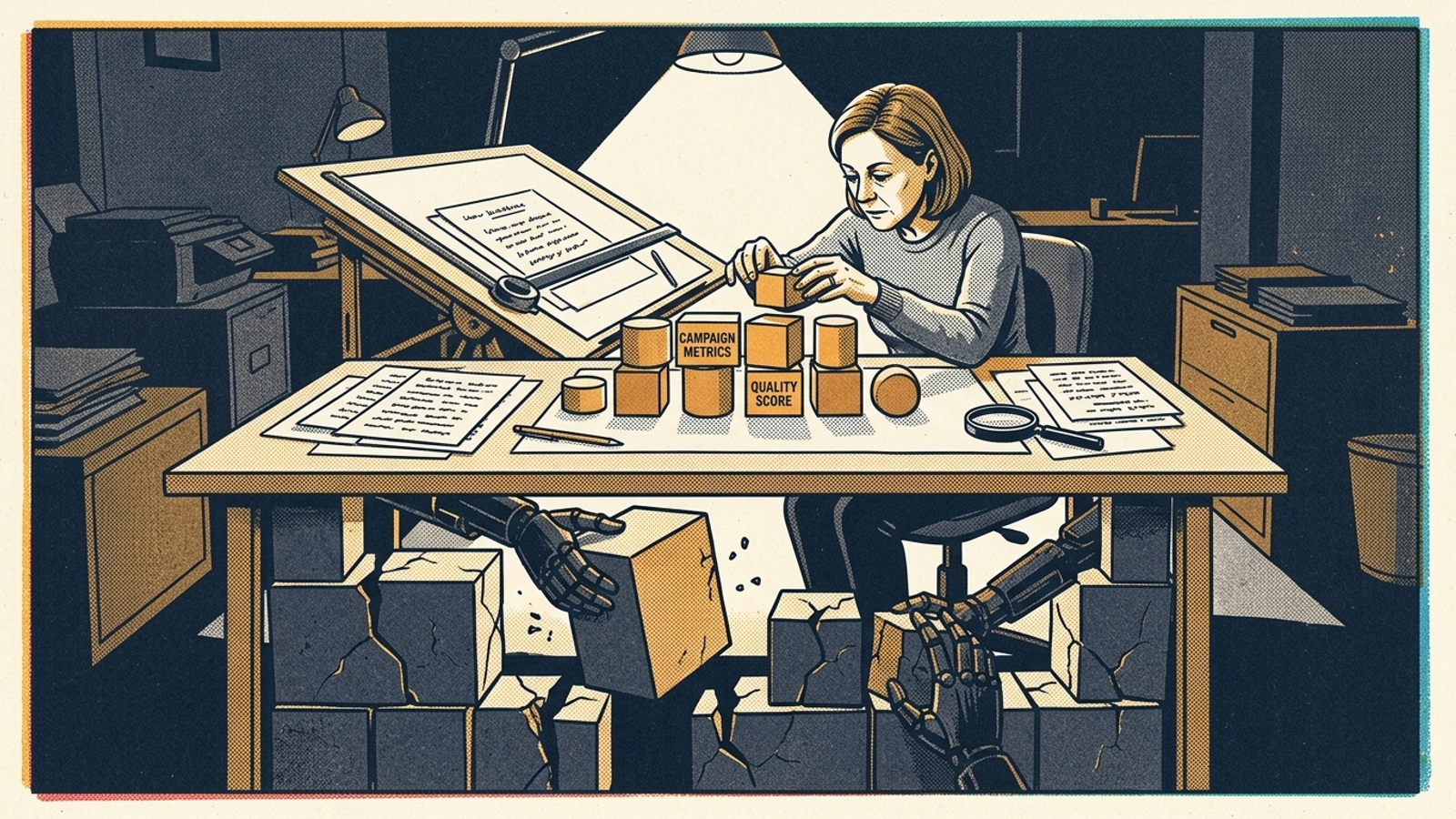
Paid search at least leaves a fairly visible trail. Click costs rise. Conversion rates fall. I can pause spend while I investigate, even if the lost efficiency stays lost. On an AI search retainer, the same silent site change can be harder to price and slower to connect to its cause. A page that supplied clear answers yesterday may stop being cited. The agency might discover that only when its next prompt-tracking run comes back. The review schedule determines how long the change can hide.
Now put the landing page on a dozen client sites.
Scene 3: Thursday afternoon on Domain #4
Picture a second composite. An agency manages twelve client domains on a white-label AEO retainer. One senior strategist, an account coordinator, and an audit dashboard cover the book. Domain #4 belongs to a freight logistics brand paying $4,500 a month. For eight weeks, the team has worked on pages intended to earn citations in Perplexity, Claude, and Google’s AI Overviews for commercial queries such as “best customs compliance software for freight forwarders.”
At 4:45 p.m. on Thursday, the client’s frontend team pushes a global template update. The agency does not get a note. To the client, this is a design change, not a search change. The new pages look cleaner: definitions move into JavaScript accordions, comparison tables sit behind lazy-loaded tabs, and a staging robots.txt configuration goes live with the release. Similar surprises turn up in accounts affected by unannounced redesigns.
The buyer-facing facts have not been rewritten, exactly. They have become harder for a crawler to reach. If a bot cannot access the page or parse the answer-bearing content, the work the agency did to make that content citable is stranded behind the new presentation. On Friday, the executive team sees a neater website. The strategist sees nothing at all, because the dashboard will not check that query again until Wednesday.
AI citations are volatile even without a bot-blocking deploy. BrightEdge’s weekly AI search benchmarks describe week-to-week domain movements in which drops, rather than gentle slides, dominate. Profound’s 80,000-prompt benchmark reports monthly citation drift of 59.3% in Google AI Overviews and 54.1% in ChatGPT. Those figures cannot tell this agency the precise hour Domain #4 lost a mention. They do make a weekly check a poor substitute for knowing what changed on the live site.
The first alert arrives five days after the deploy. By then, a citation chart can show the fall. It cannot put the old page back.
Scene 4: Wednesday’s diagnosis, next quarter’s fix
The Wednesday tracking run lands, and Domain #4’s citations have dropped. The strategist compares the live site with the version the team worked on. The direct-answer boxes are gone. Three structured tables have moved into tabs. Schema definitions have disappeared. The staging bot rule is still there.
Three hours later, the agency has a 14-point audit explaining what needs to change. The account coordinator sends it with an urgent flag. Thirty-six hours after that, the client’s engineering team replies: its sprint is committed, but the tickets can go into the next-quarter backlog.
That reply is the dead end. Agencies describe billable technical time consumed by client CMS quirks and implementation requests, and recommendations can sit in developer backlogs for months. The strategist has done the diagnosis. The client still owns the release queue. Until somebody changes the site, another report just documents the same defect in a newer font.
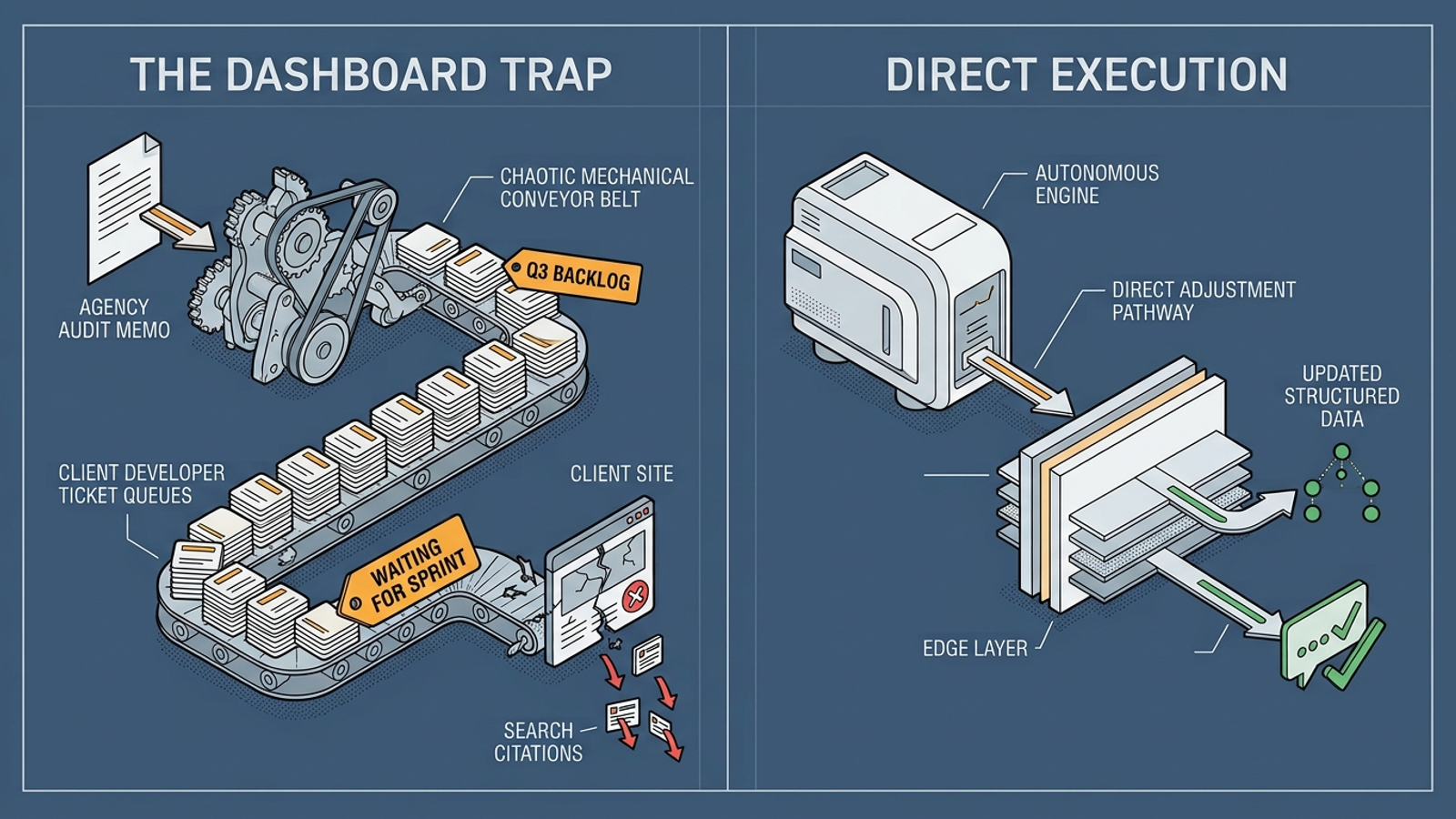
Across twelve domains, those queues multiply. One client redesigns a template. Another ships a plugin update. A third accidentally deploys a staging rule. The senior strategist stops planning new work and starts following up on old tickets. A white-label portal does not relieve that pressure. The agency GEO software sold around dashboards and reporting may show the lost mention, chart its position, and produce a client-ready PDF. Domain #4 still serves the broken page. The bottleneck is no longer diagnosis. It is permission to repair what the diagnosis found.
Scene 5: The alert has nowhere to go
On Thursday afternoon, before anyone notices the citation drop, Domain #4’s page is already different. On Wednesday, after the dashboard runs, the agency knows why. Those are two distinct gaps: time to detection and time to repair. A faster alert narrows the first one. If the agency cannot change what a crawler receives, it leaves the second one entirely in the client’s queue.
This is what bothers me about monitoring-only AEO sold as agency scale. The pitch says the software will let a small team manage more domains. Then the software finds more things that small team must explain, ticket, chase, and explain again. It is an efficient way to discover work that nobody has agreed to do. Even if the alert arrives before the weekend, the coordinator still needs to work out who can touch the page and whether that person can do it now.
In the composite, the coordinator can send another email. The strategist can attach screenshots. Neither can reach into the client’s CMS and restore the missing answer block. At 5 p.m. on Friday, that difference between seeing and doing is no longer a product-category debate. It is a live page serving the wrong material.
Scene 6: A repair route outside the sprint queue
The agency needs an authorized way to execute changes, with guardrails the client understands. One route is edge SEO using CDN workers: changes to what is served can be made at the network edge rather than waiting for a backend release. That can include restoring structured JSON-LD, correcting canonical relationships, or serving a semantic answer block when a frontend template has obscured it. It does not make every site problem an edge problem, and it does not guarantee that an AI engine will cite the page again. It gives the operator somewhere to make an authorized repair.
Before an agency offers that approach across its whole portfolio, I would test edge AEO with three pilot clients. The important questions are operational: what may the system change, who approves the boundaries, and how does the team verify what went live? In Domain #4’s case, restoring what a crawler receives is the immediate job; deciding how much of the site an outside system may alter is a separate decision. A fix that bypasses a developer queue still needs an accountable owner. Execution access matters because it turns a finding into a possible repair, not because it makes judgment optional.

That is the distinction behind groas for agencies. groas is built around autonomous execution rather than a dashboard that hands every discovered problem back to the strategist. Specialized models work continuously; a named human strategist sets direction and guardrails and remains accountable for the work. The point is not to remove the person who knows why Domain #4 matters. It is to stop making that person spend Wednesday writing instructions for a fix that may wait until next quarter.
Scene 7: The Friday question
When I look at a white-label AEO platform now, I can picture the Domain #4 coordinator opening Wednesday’s report. So I skip ahead in the sales deck and ask one question: When a client quietly breaks an answer block on Friday, what can your software actually do before Monday morning?
A Slack alert is an answer. So is a red icon, or a recommended-fixes PDF. Each tells me the agency will still have to find someone with site access and wait. I’ve laid out more of those checks in my questions to ask before buying an agency AEO dashboard. Here, the question is simpler: after the system finds the broken page, does the work move toward a repair or toward another person’s inbox?
I remember what an unannounced landing-page change did to a Google Ads account. In the composite, I am back at that spreadsheet, looking at the red cell at 1:14 a.m. Twelve domains later, there are more cells and a much prettier dashboard. The client’s new page is still live.