

 LinkedIn
Most AEO sales decks I get sent sound like someone took my old Google Ads account structure, changed the labels, and added 40% to the price. A prompt is a search term. Citation share borrows from impression share. A content gap is a keyword with no ad group.
I spent years in search terms reports and impression-share columns. Now I track how ChatGPT, Gemini, Perplexity and AI Overviews talk about businesses. Half the vocabulary is familiar. The terms with no clean PPC twin, including grounding, query fan-out and retrieval, are where vague metrics tend to hide. Here is my translation sheet: what each term means, where the analogy helps, and where a vendor might use it to sell you a number that says very little.
| AEO term | PPC twin | What to watch |
|---|---|---|
| Prompt | Search term | Who chose it matters more than how many there are |
| Prompt set | Keyword list | A short, hand-picked list can flatter you |
| Mention / citation / recommendation | Impression / click / conversion | Vendors blend three different outcomes |
| Citation share | Impression share | Denominator games live here |
| AI visibility score | Quality Score-style blend | Useful direction, dubious precision |
| Engine coverage | Search versus Display segmentation | An average hides weak engines |
| Content gap | Keyword with no ad group | Only matters if the prompt has buyer intent |
| Grounding / retrieval / query fan-out | No clean twin | Mechanisms sold as performance metrics |
| Entity / passage-level extraction | No clean twin | Slow or structural fixes sold as quick wins |
| Structured data / crawler access | Tracking and eligibility checks | Hygiene, not a guaranteed citation |
Prompt
A prompt is the question or task you give an AI engine to see what it answers.
It is the closest AEO twin to a search term, but the outputs are different. A search term triggered one auction. A prompt triggers a generated answer that might name three competitors and cite none of them. Unlike a search terms report, your test prompts are chosen by whoever builds the list. That choice can make a brand look dominant before an engine answers anything.
A prompt library of 50 to 200 prompts run weekly across ChatGPT, Perplexity and Gemini, with brands, URLs and domains logged per response, tells me more than a screenshot. Twelve hand-picked prompts where you look good do not. Ask who chose them, how they map to money, and how often they run. No prompt list, no measurement.
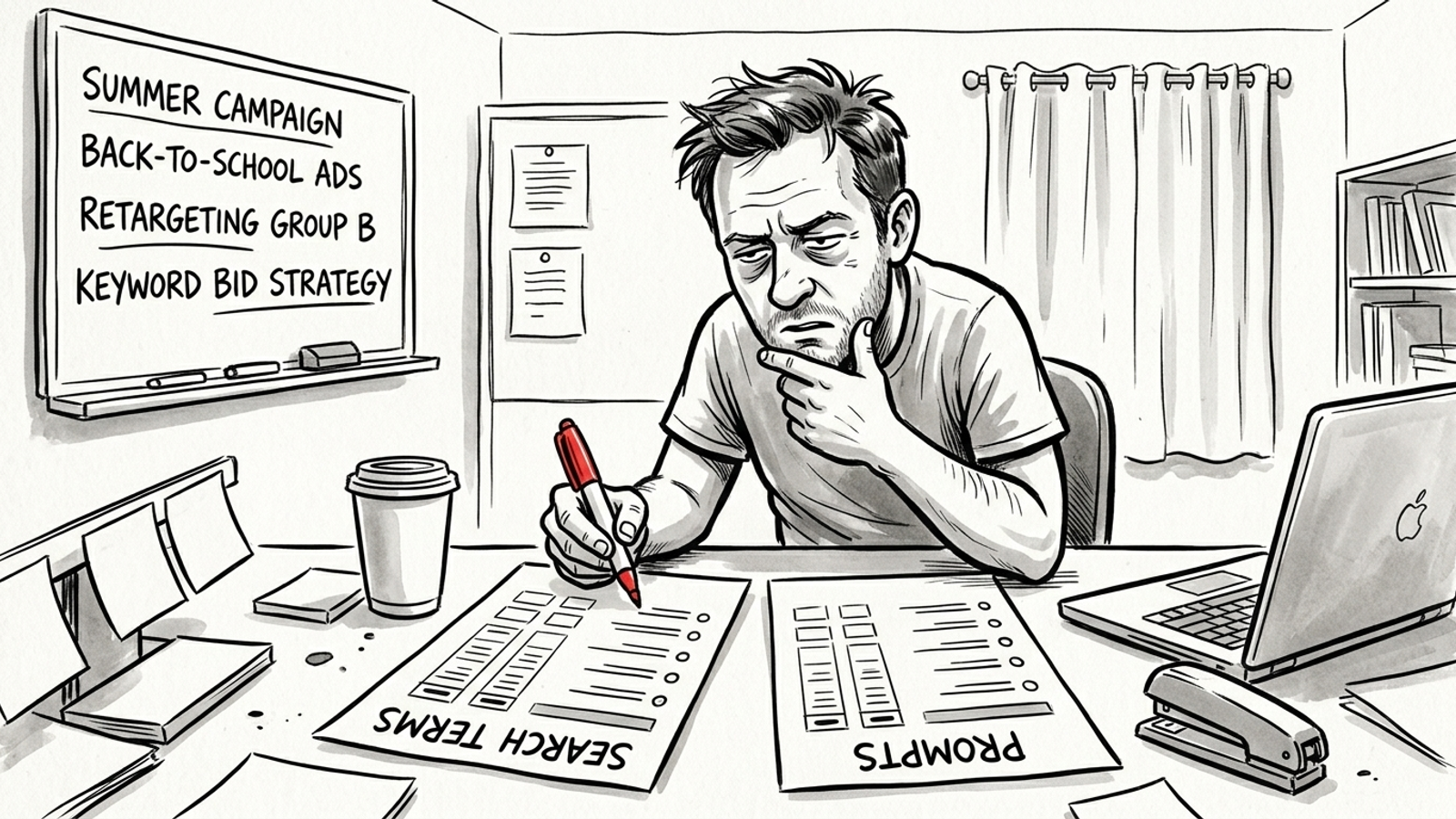
Prompt set
A prompt set is the fixed list of buyer questions you run on a schedule to track AI answers.
Think keyword list, with one catch: running it once gives you a snapshot, not a trend. Anything under 30 prompts is a demo, not diagnostics. When I ran paid search, a 12-term keyword list for an account spending, say, $20k a month told me the search term mining was not done. Same problem here.
If you are deciding whether monitoring is worth paying for, I laid out the cost-benefit math in Is AI Prompt Tracking Worth Paying For. For the vendor call, keep it simpler: ask how many prompts run, how often, and what changed in the list last month. A one-time audit is not tracking. It is a screenshot wearing a trendline costume.
Brand mention vs citation vs recommendation
A mention names your brand, a citation links or footnotes a source about it, and a recommendation tells the reader to pick it.
In PPC terms, they resemble an impression, a click and a conversion. Resemble is doing work there: an AI citation is not itself a click, and a recommendation is not a sale. Still, the distinctions matter. A mention can sit in an answer that recommends someone else. A citation may point to your page or to a third-party page about you. A recommendation expresses preference, but you still need to know whether it led to business.
Tools that roll all three into one visibility number are counting unlike things together. Make a vendor split mentions, citations and recommendations before discussing its score.
Citation share
Citation share is the portion of tracked brand appearances attributed to you rather than to your competitors.
It borrows the share idea from impression share, but it is not an auction metric. One commonly used calculation is your mentions divided by total mentions across you and competitors. If a set of answers contains 40 tracked brand mentions and 10 are yours, that measure is 25%. Do not let the label convince you those 10 were linked citations; ask what the vendor actually counted.
The misuse lives in the denominator. A vendor might count only answers containing a citation, count every prompt run, or drop an engine where you score zero. Same prompt set, different-looking shares. Get the denominator in writing: appearances of whom, across which prompts, runs and engines?
AI visibility score
An AI visibility score is a vendor’s blended number for how often you appear in tracked answers.
A simple version is answers mentioning you divided by total answers tracked. Appear in 30 of 100 answers and you score 30. That is easy to read, which is also why it is easy to oversell. I learned to distrust blends when a Quality Score of 7 could sit beside a 2% conversion rate. One tidy number hid the part I needed to fix.
High visibility with low share can mean you appear but competitors appear more. A score can also rise because the prompt list changed, not because buyers see you more often. And a score of 73.4 makes a 1.2-point weekly movement look more precise than a changing set of generated answers warrants. Use the score as a direction arrow; inspect the underlying answers and per-engine counts before acting.
Engine coverage
Engine coverage means the AI engines included in your tracking and how your presence differs across them.
I would never fold Search and Display into one PPC performance line and call it an account diagnosis. I would not blend AI engines either. The same prompt can cite a business in Perplexity and skip it in Gemini. Engines behave differently, so coverage needs a per-engine view.
A deck showing 68% coverage across all engines could hide 90% in Perplexity and 10% in AI Overviews. That average does not tell you where the gap sits. Demand separate numbers for ChatGPT, Gemini, Perplexity and AI Overviews.
Content gap
A content gap is a buyer question where competitors get cited and you do not.
The paid-search twin is a useful keyword with no ad group. First map prompts to the sources each engine cites. Then group missing prompts by intent and write answer-first content for the ones worth pursuing. Visible FAQs and off-site corroboration can support the answer. The work starts with the question, not with a writer’s target word count.
The misuse is calling every absence an opportunity. A prompt nobody with money asks is trivia, however dramatic the gap chart looks. Rank gaps by buyer intent before you write a word.
Prompt trigger
A prompt trigger is the wording or intent pattern behind prompts that get a brand mentioned.
In paid search, I would sort search terms by conversions to find the phrases doing the work. Here the pattern is looser: phrasing, intent and engine all matter. One version of a question names you; a near-identical version names two competitors. The useful job is to run the fixed set, tag mentions, citations and recommendations separately, then group the prompts that produce them.
Vendors can sell trigger discovery as proprietary AI when much of the work is careful sorting. Ask which prompts trigger competitors most often and what those prompts have in common.
Competitor citation set
A competitor citation set is the list of brands and domains that appear as sources across your tracked answers.
Think Auction Insights, but for citations rather than auctions. I want names and counts, not a slide of logos. For 100 buyer prompts, a useful table might show Competitor A cited 42 times, review sites 61 times, and your site 6 times. Those are illustrative counts, but the question is real: who occupies the answers you care about?
It may be a publisher, directory or forum rather than the rival you watch most closely. One analysis puts brand-site citations at around 4% for unbranded best-X prompts. A keyword-tool competitor list will not reveal that. If the names did not come from the answers, it is not a citation set.
Sampling variance
Sampling variance means the same prompt can produce different wording, sources and brands across runs.
Generated answers can change even when the prompt does not. I ran the same buying question three times in an hour once and got three recommended brands and two source lists. That is why a single screenshot should not start a victory lap or a crisis call.
Use scheduled runs over a fixed prompt set and decide in advance what repeated result warrants attention. Do not react to one run; look for a brand holding a prompt across three or more.
Grounding
Grounding is an AI engine using retrieved source material to support an answer rather than relying only on what it has learned before.
For Google’s search-based AI answers, that means retrieving pages from the Search index through core ranking systems. If a page is not indexed and retrievable there, its copy cannot serve as a retrieved source for that answer, however well it reads to a human.
The misuse is selling grounding as a performance score: “your grounding improved 18%,” followed by an implied promise of more citations. Retrieval eligibility is closer to ad eligibility than to an ad win. Check whether key pages are indexed and retrievable before paying to optimise them for AI answers.
Retrieval
Retrieval is the step where an engine fetches source material before generating an answer.
This is a mechanism, not a result you can invoice as “visibility.” A retrieved page might be cited, paraphrased without a link, or left out of the final answer. Paid search gave me an auction log; retrieval does not give a business owner the same tidy account of why a name appeared. When a vendor reports retrieval, ask what the final answer actually showed.
Query fan-out
Query fan-out is the step where one question becomes several related searches for source material.
Google describes one buyer question becoming concurrent related queries. Your page may answer a sub-question cleanly without being the obvious result for the original wording. That helps explain why ranking for the main query and appearing in its AI answer are not the same thing; one cited analysis found different top-10 overlap rates for AI Overview citations in its July 2025 and March 2026 samples.
The misuse is selling fan-out as a lever a vendor controls. It does not control the engine’s hidden searches. If you rank well and still get skipped, inspect the sub-questions your page answers before buying a “fan-out” fix.
Entity
An entity is an engine’s understanding of your business as a distinct thing, not just a matching string of words.
The practical work is unglamorous: a clear home page stating what you do, consistent business details, and other sites corroborating the same facts. If your name, address and offer differ across directories, an engine has more to reconcile before it can name you confidently. This is not a one-month badge a vendor can attach to a report. Fix inconsistent facts before buying another visibility dashboard.
Knowledge graph
A knowledge graph connects information about distinct things, including businesses, so an engine can resolve what a name refers to.
Google’s “things, not strings” framing is a better way to understand this than another vendor score. Organization schema with a stable @id and matching sameAs links can help state which business you mean; corroboration elsewhere still matters. The misuse is treating markup alone as proof the wider web agrees with you. Make the facts consistent first, then mark them up.
Passage-level extraction
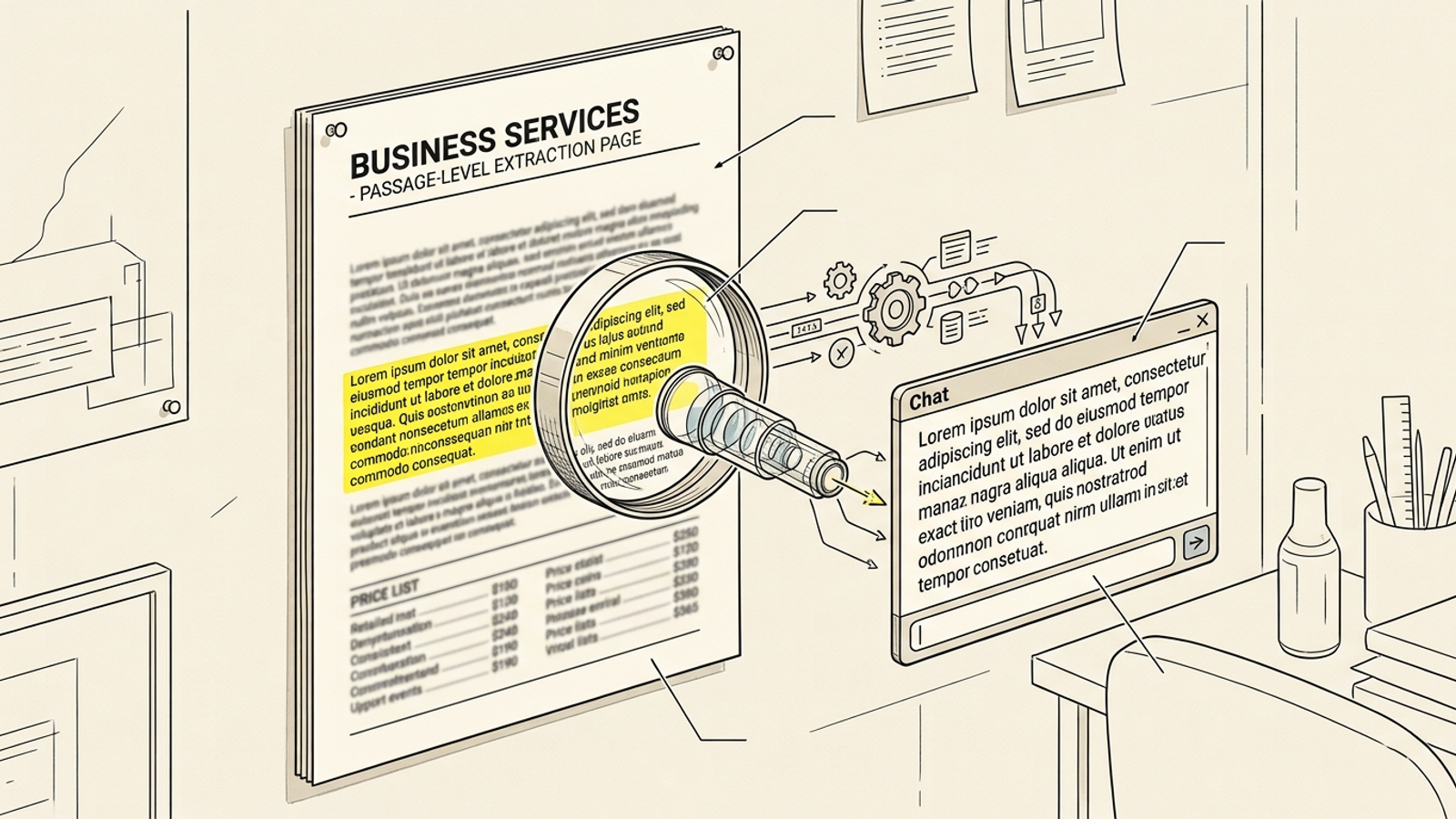
Passage-level extraction means an engine can use a self-contained part of a page to answer a question.
Think a passage that can be retrieved, quoted and attributed clearly, rather than a whole page that eventually wanders near the answer. A direct 60-word block with the answer, number and condition is easier to use than a 1,200-word page that hides the point in paragraph nine. I used to bury the price three screens down because a designer liked white space. That did not help anyone looking for the price.
The misuse is calling a long page “comprehensive” when its useful answer is hard to find. One question, one clean answer block, no preamble.
Answer-first content
Answer-first content gives the direct answer before the supporting proof and detail.
It is the writing response to a real content gap, not a magic format for every page. Map the prompt to the competitor getting cited, answer the buyer’s question near the top, add visible FAQs where they help, then pursue off-site corroboration. What the deck calls synergy, I call writing the paragraph and getting someone else to confirm it.
The misuse is publishing more words while leaving the answer buried. If the writer will not put the answer first, do not publish the page.
Structured data
Structured data is labelled code, such as Article, FAQPage and Organization, that helps an engine identify what information a page contains.
It can help with parsing and disambiguation. It does not reserve a citation slot: Google says no special schema is required for AI Overviews or AI Mode. I treat it like conversion tracking before a budget increase. Set it up properly, but do not claim it caused the win simply because it was there.
The misuse is selling schema as an AI citation trigger. If a vendor lists markup as a visibility win, ask what got cited.
Off-site authority
Off-site authority is support for your claims from sources beyond your own website.
Reviews, directories, publisher lists and forum threads can corroborate what your site says. That matters when tracked answers cite third parties instead of the brand page. One more blog post on your own site will not, by itself, fix a gap caused by missing corroboration.
Start with an answer worth confirming on your site, then work on getting the same facts represented elsewhere. Budget for credible mentions, not just more pages.
AI crawler access
AI crawler access is whether the bots associated with AI systems can fetch your pages under your robots.txt rules.
The bot names are not interchangeable. OAI-SearchBot, Claude-SearchBot and PerplexityBot are associated with search answers, while GPTBot, ClaudeBot and CCBot are associated with training collection. Google-Extended is a control token, not a crawler, and AI Overviews follow Googlebot.
The misuse is treating “block AI” as one switch while still expecting live answer systems to fetch your pages. Rules for training and rules for search answers are separate decisions. Write down the behaviour you want for each bot before changing access.
Before signing with an AEO vendor, I would ask for five definitions: the prompt list, the mention-versus-citation split, the citation-share denominator, per-engine results, and the repeat threshold for calling a change real. If those cannot be explained plainly, you are buying a score, not measurement.
AI visibility score
An AI visibility score is the blended visibility number I would retire.
It is Quality Score cosplay. Keep the prompt-level answers, the mention and citation counts, and the engine split. Drop the blend. That is why groas reports mentions and citations per engine instead: cause first, then the number.