

 LinkedIn
Most AI visibility reports hand you one rising number. It can hide three very different events: a model named your brand, linked your page, or told a buyer to choose you.
I used to hand clients blended numbers in paid search, back when an impression and a conversion could hide inside the same “performance” column if nobody looked closely. Being mentioned is not being cited, and being cited is not being recommended. One puts your name on the screen. One gives the buyer a source to click. One makes a case for picking you. Rolling them into a visibility score repeats the impressions-versus-conversions mistake paid search spent years unlearning.
Use this glossary the way I use it on a call. When a tool says “visibility,” ask which event happened, on how many prompts, and what the buyer could do next. The terms follow the order you meet them: outcomes first, then the inputs behind them, then the plumbing vendors point to when the outcomes look thin.

Mention
Definition: the model typed your brand name in the answer, with or without a link. That is it. A mention can happen with no link attached, which is where a lot of audits fall apart. I measure mention rate as prompts where you were named divided by total prompts. Run 20 non-branded buyer prompts, get named in 6, and your mention rate is 30%.
The misuse: counting a passing name-drop in position seven of a list-style answer the same as a place on a head-to-head shortlist. I used to tell clients impressions meant demand. I was wrong. Mentions are the new impressions: count them, then ask what they led to.
Citation
Definition: the answer linked your URL as a source for something it said. A mention puts your name on the screen. A citation puts your page underneath a claim, usually as a small link or footnote the buyer has to notice and click. I track citation rate as prompts where your URL was linked divided by total prompts. If 50 buyer prompts produce 8 links to your site, that is 16%, even if your mention rate is twice as high.
The gap matters because citations are fragmented across models: one study of 3.7M cited URLs found 91% appeared in only one LLM. A citation in ChatGPT tells you little about whether Gemini will cite you. Ask for citation rates per engine, not one blended rate.
Recommendation
Definition: the model told the buyer to pick you. Not merely listed you or footnoted you. Chose you, in plain words, as the answer to a buying question. Of the three events, this comes closest to the decision you care about, though a recommendation in an answer is not itself a sale.
The wording does the work: “best for,” “start with,” “if you need X, use Y.” What the deck calls sentiment, I call whether you were the suggestion or the afterthought. Vendors stretch this term hardest by counting any top-three placement as a recommendation. I count it only when the answer actually favors you. A list placement without a choice is still a mention, wearing better clothes.
Share of voice
Definition: your slice of all brand mentions in the answers, not the share of prompts where you appeared. The denominator is the trap. Presence rate counts prompts where you were named divided by total prompts: 30 of 100 prompts means 30% presence. Share of voice counts your mentions against mentions of you and named competitors. If competitors appear in those answers too, 30% presence does not mean 30% share of voice.
I want both numbers side by side. Then I want the layers behind them: mention share for breadth, citation share to see whose pages get linked, and the wording that tells me whether my brand was the pick or the backup. A vendor reporting presence as share of voice has changed the denominator without telling you. Make them show it.
Prompt and prompt set
Definition: a prompt is the question you feed the model, and a prompt set is the fixed list of questions you track over time. Every rate in this glossary depends on what you chose to ask. A list full of your own brand name will tell a nicer story than a list of non-branded buying questions. Neither result means much until you know which questions produced it.
For a working set, aim for 50 to 200 prompts and split them across informational, commercial, and transactional intent, including recommendation, comparison, and problem-solving questions. Then:
- Keep the list fixed so you can compare one run with the next.
- Track at least three engines, run each prompt multiple times, and report results per platform. Answers change between runs; a single lucky answer is not a trend.
- Start with the 30-Prompt Test for AI Search Visibility if you need a concrete list to build from.
No fixed set, no useful trend line. Just anecdotes with a logo on top.
Answer mapping
Definition: answer mapping is the row-level record tying each prompt run to its answer, named brands, and cited URLs. One row per run: date, engine, prompt, your mention yes or no, your citation yes or no, and who else appeared. Add the answer itself so you can check whether a claimed recommendation was actually one.
It is boring work. It also stops a vendor from cherry-picking screenshots. The same prompt can return different brand lists from run to run; without the mapping, you cannot tell a shift from a lucky pull. Charts without the rows underneath are a brochure, not an audit.
Content gap
Definition: a content gap is a buying question in your tracked prompts that your site has no good page to answer. Not a keyword you forgot. It is a question the answer needs help with, while another site has a useful page the model can cite.
I look for mapped answers where a competitor was cited and we were only mentioned. Then I read the cited page. Did it supply a definition, a price range, a comparison table, a dated proof point? That missing block may be the gap. The temptation is to chase the prompt score first. Fix the page that could answer the question, then see whether the citation changes.
Entity
Definition: your entity is the set of associations that tells a model what your brand is, beyond the words on your homepage. Think category, locations, products, reputation, and the other brands that appear beside you. This helps explain why two companies with similar pages can show up differently in answers.
One has a consistent footprint across reviews, directories, and press. The other has five descriptions, three old addresses, and a name that collides with something else. Consistent third-party descriptions give the model a clearer basis for placing you; conflicting ones make that placement harder. If your positioning changes by site, clean up the footprint before blaming one page.
Passage
Definition: a passage is the short stretch of a page an answer can use to support a specific claim. A page may cover the right topic and still make the relevant answer hard to find. A dense paragraph that buries the price range, definition, or comparison forces more work than a direct, self-contained block.
This is where citation-ready content turns into a volume pitch: more pages, more chances. I would rather see one page answer the buying question plainly than ten pages circle it. Look at the pages your mapped answers cite, then ask whether yours offers an equally usable passage. Give each important question a quotable answer, not another paragraph of scene-setting.
Training crawl vs live-answer fetch (GPTBot vs ChatGPT-User)
Definition: training crawls and answer-time access are different ways OpenAI may reach your site, with separate controls. GPTBot handles training crawls, OAI-SearchBot supports search discovery, and ChatGPT-User fetches pages in response to user requests. Blocking one is not the same as blocking them all.
I see the confusion in both directions: a site owner blocks GPTBot to “keep AI out” and wonders why a page can still appear in an answer, or blocks everything and wonders why it has disappeared. Training access and access to a page for an answer are different questions. Check which bot you blocked before declaring that AI can or cannot see you.
Verified vs spoofed bot hits
Definition: verified bot hits are visits confirmed as real crawler traffic, rather than requests merely claiming a bot’s name. A user-agent string is easy to fake, so a GPTBot hit in a log needs verification against OpenAI IP ranges. Log counts can mislead in both directions: a CDN can reject a real bot while robots.txt says it is allowed, and a scraper can pretend to be GPTBot.
The reported blocking pattern is lopsided too: among 40 major sites, 18% blocked GPTBot and 12% blocked OAI-SearchBot, with blocking concentrated in media rather than SaaS. That does not tell you what happened on your site. Treat an “AI bot visits up 300%” chart as unverified until someone shows the check.
Grounding and retrieval
Definition: grounding and retrieval mean looking up outside information to support an answer instead of relying only on what the model recalls. In retrieval-augmented generation, the system fetches external documents and uses that context to write an answer. What it retrieves matters. So do the passages it selects and the order in which it weighs them.
This is the mechanism behind many citations: the system needs a source it can access and use while producing the answer. A strong page that the relevant search system cannot find is not doing much work for you. Check access and the quality of the passage before celebrating a page’s existence.
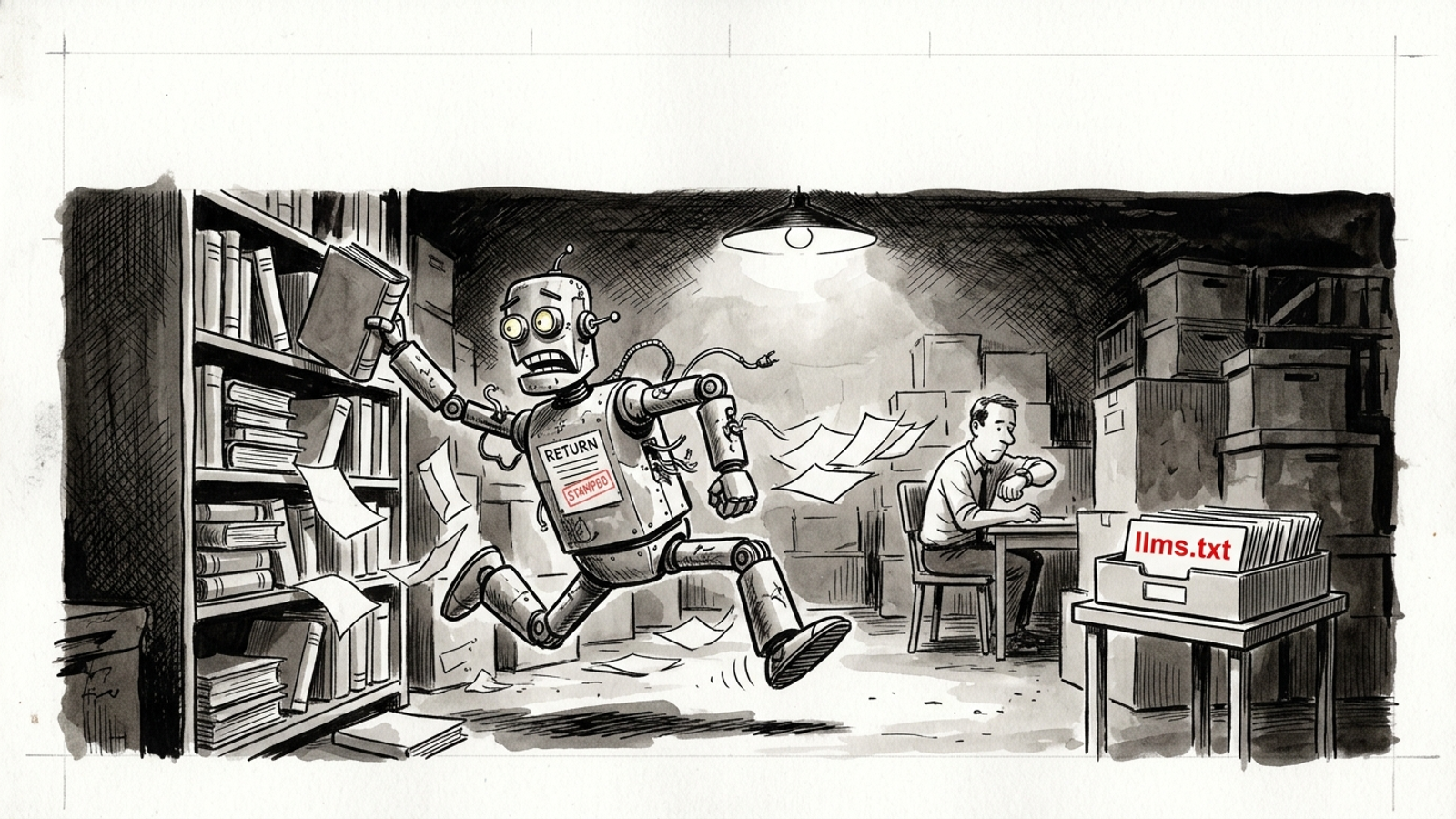
llms.txt
Definition: llms.txt is a voluntary text file some sites publish to summarize themselves for models, without an established visibility payoff. The pitch is that a tidy /llms.txt helps you get cited. The 94k-citation dataset here offers little reason to put it first: only 1 of the top 50 most-cited global domains had the file, while none of the top 50 German ChatGPT brands or top 20 cited news domains did.
It is a suggestion, not a permission slip or an indexing directive. I would skip it for now unless your developer has ten spare minutes. Crawlable pages, useful passages, and consistent descriptions elsewhere deserve attention first. Publish the file if you like tidiness; do not report it as a win.
‘AI impressions’
Definition: “AI impressions” counts answers where your brand appeared and borrows the language of paid-search impressions. Paid impressions describe ads served into auctions. A tracked AI answer is one run of one prompt, not a measure of how many buyers saw your brand. Calling both an impression makes the chart look familiar while hiding what its count represents.
The fix is the one paid search learned: put visibility counts beside branded search, direct traffic, and what AI-referred visitors do when they reach your site. Do they land on service pages or leave from blog posts? I trust a citation that sends five buyers to a money page over 50 mentions that send nobody anywhere. Ask what the buyer did next, not how often your name rendered in a test.
‘Visibility score’
Definition: a “visibility score” is a vendor-made composite that compresses different AI answer events into one number. This is the term I would retire. Mentions, citations, and list placements can all move that number, but they do not mean the same thing. There is no stable ranking to score against, answer lengths and links vary, and prompt-volume data is missing. Worse, the same discussion reports that 44% of real B2B prompts already contain brand names. A tool that tracks only generic prompts may be scoring a different set of questions from the ones buyers ask.
When a tool leads with the composite, I ask for three separate numbers, per engine, with the row-level answers underneath:
- Mention rate: prompts where you were named divided by total prompts. Did you appear at all?
- Citation rate: prompts where your URL was linked divided by total prompts. Could the buyer click through to you?
- Recommendations: prompts where the answer actually picked you. Did its wording favor you, or just include you?
For a repeatable way to inspect those answers, start with How to Measure Brand Visibility Across ChatGPT, Gemini and Google AI Overviews. At groas, we keep tracked prompts, answers, citations, and share of voice separate rather than average them into one dial. If a report cannot show the three events behind its score, it is selling you the feeling of coverage. Retire the term. It is an impressions deck with a new haircut, and paid search already learned that lesson the expensive way.